- AI&TFOW
- Posts
- AI’s New Rules Of Work [Newsletter #75]
AI’s New Rules Of Work [Newsletter #75]
How to Stay Relevant

AI and the Future of Work
November 25, 2025
Hello, AI enthusiasts from around the world.
Welcome to this week’s newsletter for the AI and the Future of Work podcast.
The AI revolution is accelerating fast, and uncertainty may grow with it.
Moments like these aren’t new. Every major shift in how we work has forced us to rethink our assumptions and adapt.
That’s why mindset matters. Today’s conversation explores how to use AI as a tailwind instead of resisting the change happening around us.
Let’s dive into this week’s highlights! 🚀
🎙️ New Podcast Episode with Jeetu Patel, Cisco President and Chief Product Officer
What differentiates you from the rest in these evolving times?
It’s a question everyone must face, whether you’re an individual contributor or part of one of the world’s largest networking companies.
Humanity is navigating a major shift in how we work. AI’s rapid evolution brings hope and excitement, but it also introduces uncertainty, especially as people worry about what automation means for their jobs.
Jeetu Patel prefers to flip that perspective, and he starts by answering the question head-on.
What will set you apart today, and in the future, isn’t knowledge. Knowledge is everywhere. Your edge will come from how you solve problems.
No one should work against a megatrend. The goal is to use it as a tailwind.
It’s a philosophy Jeetu has embraced as President and Chief Product Officer at Cisco, where he has led a cultural shift toward becoming an AI-first company.
Jeetu joined Cisco in 2020, right before AI reached mainstream awareness, after serving as Chief Product Officer and Chief Strategy Officer at Box. There, he helped transform the company into a multi-product platform trusted by more than 100,000 customers.
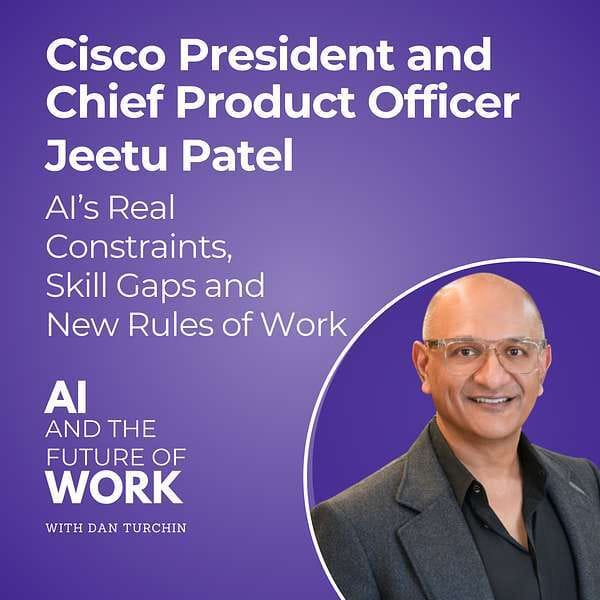
PeopleReign CEO Dan Turchin sat down with Jeetu to explore how one of the world’s biggest networking companies reinvented itself to thrive in an AI-first future, not just survive it.
To succeed, Jeetu reshaped the company’s culture by tying bonuses to AI adoption and by recognizing that AI already performs certain tasks better than humans. At the same time, he highlights what only people bring to the table: instinct, judgment, and passion.
In this conversation, they discussed:
Why fully embracing AI has become a requirement at Cisco, not a choice.
How AI will reshape every job, including the ones we haven’t imagined yet, and why human skills will remain essential.
Why skill gaps are growing, and what workers can do to stay relevant as AI transforms the workplace.
The real constraints slowing enterprise AI adoption, including power, trust, and data.
The infrastructure, security, and data gaps limiting AI’s potential, and how Cisco is working to close them.
🎧 This week's episode of AI and the Future of Work, featuring Jeetu Patel.
Tune in to hear Jeetu share his vision for Cisco and why he’s optimistic about a future where AI and humans work together. Connect with Jeetu on LinkedIn to learn more about his work.
📖 AI Fun Fact Article
Low wages, alleged union busting, and even trauma became part of daily life for workers at Sama, Facebook’s largest content moderation provider in Africa. Conditions were so severe that a former moderator sued both Sama and Meta, claiming they violated the Kenyan constitution.
As Billy Perrigo reports in Time, Sama has now announced that it will no longer work with Meta. The contract, worth $3.9 million, began in 2022 and focused on reviewing harmful content across Meta’s platforms.
After ending the relationship, Sama attributed the decision to the country’s economic climate, without mentioning the lawsuit. NGOs supporting the case criticized both companies, pointing to how these decisions reveal deeper problems with online content moderation and how little progress has been made in addressing them.

Source: Sama's office in Nairobi, Kenya. Photographed on Feb 10, 2022. Khadija Farah for TIME
PeopleReign CEO Dan Turchin reminds us that every for-profit company is driven by a single objective: increasing shareholder value. As we all know, if you’re not paying for the product, as is the case with most social media apps, you are the product.
Companies like Meta, Google, and TikTok (and its parent ByteDance), will use your personal data in whatever way is required to increase clicks, time spent scrolling, and revenue per impression.
Caught in the crossfire is the mental health and well-being of every subscriber. As noted in today’s article, the same applies to every content moderator exposed to the harmful material that never reaches your feed.
It’s fair to assume that every ad-supported tech company started with good intentions to democratize access to unbiased, crowdsourced content. Over time, those intentions came into conflict with revenue targets.
We have seen governments and companies like Google compromise their integrity by partnering with organizations accused of using AI to exert harm.
It should come as no surprise that content moderation is often used as a human shield, protecting brand equity until it threatens profit margins. You are the product, so vote with your eyeballs.
It’s more important than ever to take responsibility for understanding how content enters your feed, including the possible human cost behind it.
Listener Spotlight
Todd from Detroit is the CIO of a logistics company. His favorite episode takes us back to season three, featuring Joel Eagle, IT executive at McDonald’s, who shared how AI helps serve 70 million meals every day.
🎧 You can listen to that excellent episode here!
As always, we love hearing from you. Want to be featured in an upcoming episode or newsletter? Comment and share how you listen and which episode has stayed with you the most.
We want to hear what you have to say! Your feedback helps us improve and ensures we continue to deliver valuable insights to our podcast listeners. 👇
Lawyers Are Entering a New Era of AI
AI and the law is a conversation that is moving fast.
Last week we released a special compilation that brings together five leaders who see the future from very different angles.
Robert Plotkin explains how ownership, prompts, and data rights are shifting.
Jim McKenna shows what it takes to innovate without losing compliance.
Scott Stevenson talks about responsible legal AI and why humans must stay in control.
Rafie Faruq breaks down the real risks behind automated contract work.
Tamara Steffens shares how AI is reshaping the careers of tomorrow’s lawyers.
If you want a clear snapshot of how technology is changing the legal world, this compilation is a solid place to start.
🎧 Listen to the full AI and the Law compilation on AI and the Future of Work with Dan Turchin.
📽️ Worth a Watch
Could AI layoffs backfire on employers?
Generative AI has streamlined many processes and removed the need for certain roles. We’ve covered this before, but there’s another challenge inside companies that often gets overlooked: The people who stay may struggle to move up.

Source: Getty Images
This affects workers, yet it also raises an important question for companies. What happens when entry-level employees have fewer opportunities to grow?
The video breaks down why every organization, no matter how advanced its AI tools become, still depends on human talent. If career growth stalls at the bottom, the talent pipeline may weaken over time.
Watch the video to learn more.
Culture of Wow in Service Teams
Great service starts with culture, not perks.
PeopleReign is hosting a free live session where Ben Brennan and Maddie Blumenthal will explain the leadership practices and team habits that help support organizations deliver consistently strong experiences.
📅 December 4
🕘 9:00 to 10:00am PDT
Reserve your seat here.
Until next time, stay curious! 🤔
We want to keep you informed about the latest developments in AI. Here are a few stories from around the world worth reading:
The Trump administration is renewing efforts to block states from regulating AI. Learn why this is raising new safety concerns.
Patients are now using AI tools to challenge insurance denials that were made using AI. Read how the tables have turned.
The holidays are approaching, and advocacy groups are weighing in on AI toys for children. Here’s what they have to say.
That's a Wrap for This Week!
“What will happen to my job?” This week’s conversation explored that question from a different angle.
AI will reinvent how we work, and the path ahead is still unfolding. Our role is to grow alongside it.
We hope this issue encouraged you to approach these changes with the strengths only humans bring to the table, including passion, curiosity, and instinct. 🎙️✨
If you liked this newsletter, share it with your friends!
If this email was forwarded to you, subscribe to our Linkedin’s newsletter here to get the newsletter every week.