- AI&TFOW
- Posts
- How AI Is Reshaping Learning at Work [Newsletter #82]
How AI Is Reshaping Learning at Work [Newsletter #82]
From Training to Daily Impact

AI and the Future of Work
January 13, 2026
Hello, AI enthusiasts from around the world.
Welcome to this week’s newsletter for the AI and the Future of Work podcast.
AI now touches nearly every part of an organization, but learning feels the shift most directly. Resistance often fades once employees begin experimenting with AI in their daily work.
That experimentation creates momentum. As people grow more comfortable using AI, repetitive tasks recede. Time opens up for deeper learning, stronger skills, and more meaningful professional contribution.
Organizations benefit as well. Teams that learn how to work with AI increase productivity without defaulting to headcount reduction.
This week’s conversation makes one point clear. None of this happens without leadership. When leaders disengage, adoption slows. When they participate, learning accelerates.
Let’s dive into this week’s highlights! 🚀
🎙️ New Podcast Episode with Kimberly Williams, CEO of Absorb
When email first started gaining traction inside organizations, Kimberly Williams noticed something she never forgot. She still shares this story in leadership meetings.
Email was becoming central to corporate communication. But her former CEO did not know how to use it. He asked his assistant to print every message. He would handwrite a reply and have the assistant type and send it as an email.
The process worked, but it was slow and inefficient. The alternative was simple. The CEO needed to learn the tool and use it himself.
Now, with the AI shift well underway, Kimberly often returns to this memory. She shares it not only as a reflection, but as a lesson for the many organizational leaders she works with.
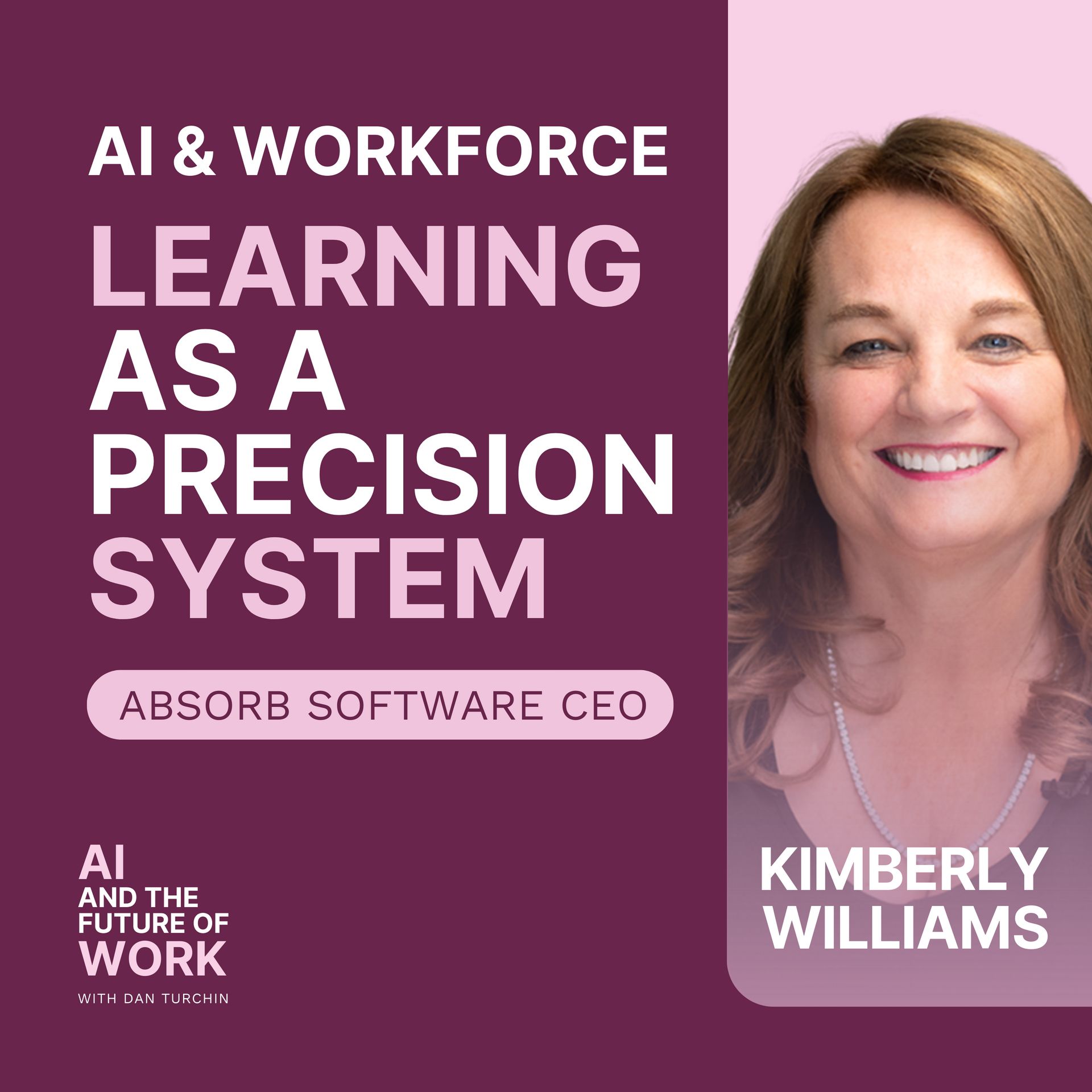
Kimberly is the CEO of Absorb Software, which is used by more than 3,300 organizations and 34 million employees to shape learning at work. She also serves on the boards of EquiLend and TrueCommerce.
She is part of the Enterprise Software CEO Roundtable, which brings together 50 peer CEOs from companies such as Workday, OpenText, and UKG. She also serves on the Tampa membership committee for the Women’s Corporate Directors Association.
PeopleReign CEO Dan Turchin sat down with Kimberly to explore how resistance to learning AI mirrors past technology transitions. Leaders play a critical role in pushing teams to experiment and apply AI in daily work. Sometimes, leadership starts by forcing yourself to find practical reasons to use the tools first.
This week’s conversation covers this and much more:
AI is shifting corporate learning away from rigid, cohort-based training toward personalized, individual learning paths.
The future of learning lives inside daily workflows, not in separate LMS portals.
Early-career professionals do not need to fear AI. Used well, AI removes low-value work and accelerates exposure, leading to greater impact at work.
Reskilling and redeploying talent matter if companies want to grow by expanding output with AI instead of shrinking teams.
L&D teams play a central role in AI learning. They become “model trainers,” embedding culture, values, and context into AI systems
🎧 This week's episode of AI and the Future of Work, featuring Kimberly Williams, CEO of Absorb.
Listen to the full episode to hear how Kimberly encourages leaders to ask, “How do I use AI?” at the start of a task rather than treating AI as a last step.
📖 AI Fun Fact Article
Writing in HR Brew, Paige McGlauflin shares findings from a 500-person survey commissioned by EdAssist. The data shows strong motivation across the workforce to learn with AI.
86% of workers want to build new skills at work using AI.
45% already use AI to move faster through learning and develop skills more efficiently.
Age plays a clear role in adoption. Gen Z employees show higher interest in using AI across multiple areas.
43% of Gen Z respondents want AI upskilling to improve work-life balance, compared with 35% overall.
42% want AI upskilling to focus on more meaningful work, compared with 31% of all respondents.
Intent does not always lead to action. The gap often comes down to skills. Many workers struggle to write effective prompts or assess the quality of AI-generated output. Without those skills, motivation alone falls short.

Source: Gillespie, N., Lockey, S., Ward, T., Macdade, A., & Hassed, G. (2025). Trust, attitudes and use of artificial intelligence: A global study 2025. DOI 10.26188/28822919
PeopleReign CEO Dan Turchin notes that much of what this study reveals feels intuitive. What stands out more is what the study does not address.
Skills development, at work and in life, should be driven by purpose and by a desire to spend more time on what matters most. The cultural moment around AI should not be the primary reason people pursue upskilling.
Every conversation about learning should begin with a simple question. How will these skills improve your life?
The skills journey should be motivated by a desire to be a better employee, parent, spouse, or friend. We should aspire to do more of what we love.
Skills are not an end. In fact, the only reason to learn about AI, or anything else, is to achieve something greater. Career uncertainty caused by AI is the perfect opportunity to find something greater.

Free Assessment
Listener Spotlight
Lirit is a lab director based in Pensacola, Florida. Lirit’s favorite episode comes from Season Four and features Robert Plotkin, a well-known author and expert in AI and intellectual property law. The conversation focuses on LLM regulation and legal guidance for entrepreneurs working with AI.
🎧 You can listen to that excellent episode here!
As always, we love hearing from you. Want to be featured in an upcoming episode or newsletter? Comment and share how you listen and which episode has stayed with you the most.
📽️ Worth a Watch
Geoffrey Hinton, often called the “Godfather of AI”, is known for his foundational work on artificial neural networks and his time at Google Brain. In 2023, he left Google and spoke openly about his concerns around AI risk and the speed of development.
Hinton has never avoided hard questions. In late 2025, he returned to many of the warnings he raised two years earlier. The conversation now centers on whether his views have shifted, and what still worries him most.

Source: YouTube CNN
You can watch this thoughtful conversation between Geoffrey Hinton and journalist Jake Tapper to hear his latest reflections on AI and where he believes things are heading.
We'd love to hear from you. Your feedback helps us improve and ensures we continue bringing valuable insights to our podcast community. 👇
Recommended Episode
If the holidays pulled you away last week, here’s a conversation worth coming back to:
Cisco CPO Kelly Jones joined Dan Turchin to share a lesson many organizations overlook.

Tune in to the full conversation in Episode 369 of AI and the Future of Work.
Until Next Time: Stay Curious 🤔
We want to keep you informed about the latest developments in AI. Here are a few stories from around the world worth reading:
AI is influencing who police stop and question. This piece explores both the benefits and the risks of using AI in policing.
University applicants face new pressure as AI plays a role in admissions decisions. The article also raises important concerns.
A marathon runner replaced her personal trainer with AI. Here is what worked and what surprised her.
👋 That's a Wrap for This Week!
Fear often surfaces when workers hear repeated messages about AI taking jobs. The speed of AI’s evolution adds to that anxiety. But the story does not end there.
The first step toward easing this fear starts with learning. Understanding how AI tools work changes how people relate to them and how they use them.
This week’s conversation shows how a willingness to learn benefits both employees and organizations. It also reinforces why leadership attitude matters so much in this process.
If you lead a team, we hope this discussion encouraged you to engage with AI yourself so you can help others do the same.
If you liked this newsletter, share it with your friends!
If this email was forwarded to you, subscribe to our Linkedin’s newsletter here to get the newsletter every week.